The Greenhouse Gas Laboratory
Projects

«Tazovsky» Research Site: Greenhouse Gas Studies in Tundra Ecosystems (2023–2025)
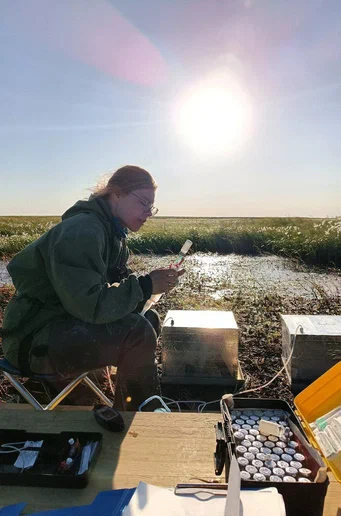
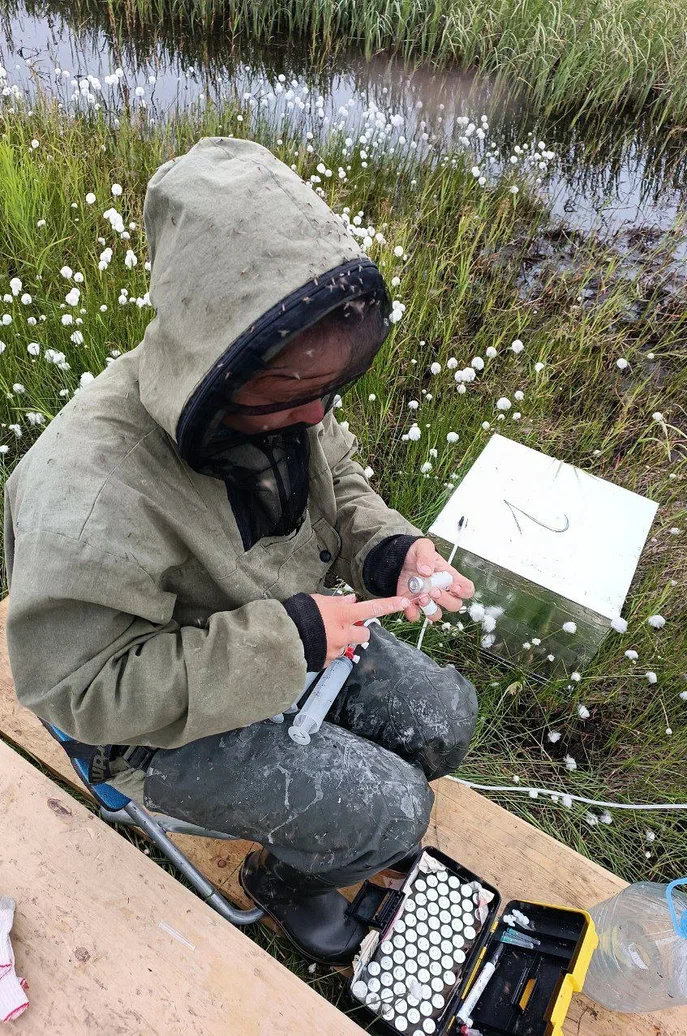
In 2023–2025 the Laboratory conducted a series of comprehensive field expeditions at the Tazovsky research site, located 11 km south-southeast of the settlement of Tazovsky (Tazovsky District, Yamalo-Nenets Autonomous Okrug). The objective of the project was to investigate methane and carbon dioxide emissions from natural tundra ecosystems and to identify environmental drivers controlling the spatial and temporal variability of gas exchange between the land surface and the atmosphere.
The study encompassed mineral soils, peatlands, lakes, and drained thermokarst lake basins. Systematic measurements of methane and carbon dioxide fluxes were conducted throughout the summer season and resulted in representative datasets on the intensity of greenhouse gas emissions and uptake across diverse ecosystem types.
The acquired data were used to develop mathematical descriptions of 24-hour flux dynamics from lakes and wetlands and to analyze the spatial heterogeneity of methane emissions. Seasonal emission estimates were derived and key hydrological, physicochemical and landscape controls were identified. Detailed spatial mapping of the research site was carried out using satellite data and UAV imagery. The integration of field measurements and remote sensing enabled characterization of ecosystem spatial structure and its relationship to greenhouse gas emission patterns.
Studies of Greenhouse Gas Emissions from EN+ Group Reservoirs (2020–2025)
From 2020 to 2025, the Laboratory conducted systematic field investigations of methane and carbon dioxide emissions from large Siberian reservoirs within projects implemented in the interests of EN+ Group. Between 2020 and 2023 large-scale studies were carried out at the Irkutsk Reservoir, Bratsk Reservoir and Ust-Ilimsk Reservoir, involving data collection and analysis using laboratory techniques, statistical methods and GIS technologies. In 2024–2025, similar investigations were conducted at the Krasnoyarsk Reservoir. Measurements included determination of specific methane and carbon dioxide fluxes, their spatial heterogeneity and seasonal variability. All studies were conducted in strict compliance with the methodological recommendations of the International Hydropower Association (IHA). The results were verified and certified by the international auditor TUV Austria.
Studies in the «Zhuravlinaya Rodina» Nature Reserve (2025)
Research conducted in the «Zhuravlinaya Rodina» Nature Reserve focused on greenhouse gas exchange between wetland ecosystems and the atmosphere within the Dubna peatland massif. Particular attention was given to assessing methane and carbon dioxide fluxes, their seasonal variability and their relationship with environmental physical parameters. Field observations were carried out during the warm season (June–October 2025) using the static chamber method. Concurrently, meteorological and hydrological parameters were recorded, including air and soil temperature regimes and water table levels. These investigations provided representative field data on the functioning of both natural and disturbed peatland ecosystems as sources and sinks of greenhouse gases.
| Vladimir Kazantsev | Head of Laboratory, Senior Researcher | Manager |
| Aleksandr Ginzburg | Chief Scientist | |
| Aleksandr Sabrekov | Junior Researcher | |
| Alexander Zhernenko | Research Engineer | |
| Andrei Belov | Research Engineer | |
| Anna Usachiova | Researcher | |
| Arina Larina | Research Engineer | |
| Elena Tsvetnova | Research Engineer | |
| Elena Zhihareva | Engineer | |
| Georgiy Gavrilov | Research Engineer | |
| Liudmila Krivenok | Junior Researcher | |
| Mariya Shvets | Research Engineer | |
| Mikhail Latonin | Researcher | |
| Natal'ia Svirida | Research Engineer | |
| Nikita Ustinov | Research Engineer | |
| Viktor Lomov | Researcher | |
| Vladimir Kaganov | Research Engineer |

About the Laboratory
The Greenhouse Gas Laboratory was established in 2022 at the A. M. Obukhov Institute of Atmospheric Physics of the Russian Academy of Sciences as a continuation of a research group within the Laboratory of Mathematical Ecology, which has been investigating atmospheric methane and carbon dioxide sources across northern Russia since 2009. The establishment of the Laboratory enabled the institutional consolidation of long-term field and analytical research and its integration into a comprehensive framework for studying greenhouse gas emission processes in natural and anthropogenic ecosystems of the Arctic and subarctic regions. Northern West Siberia represents a key, though not exclusive, focus area of the Laboratory’s research, with ongoing expansion of field activities to other regions of the Russian Federation. The Laboratory conducts both fundamental and applied research and also contributes to the training of young specialists and provides methodological support to research teams.
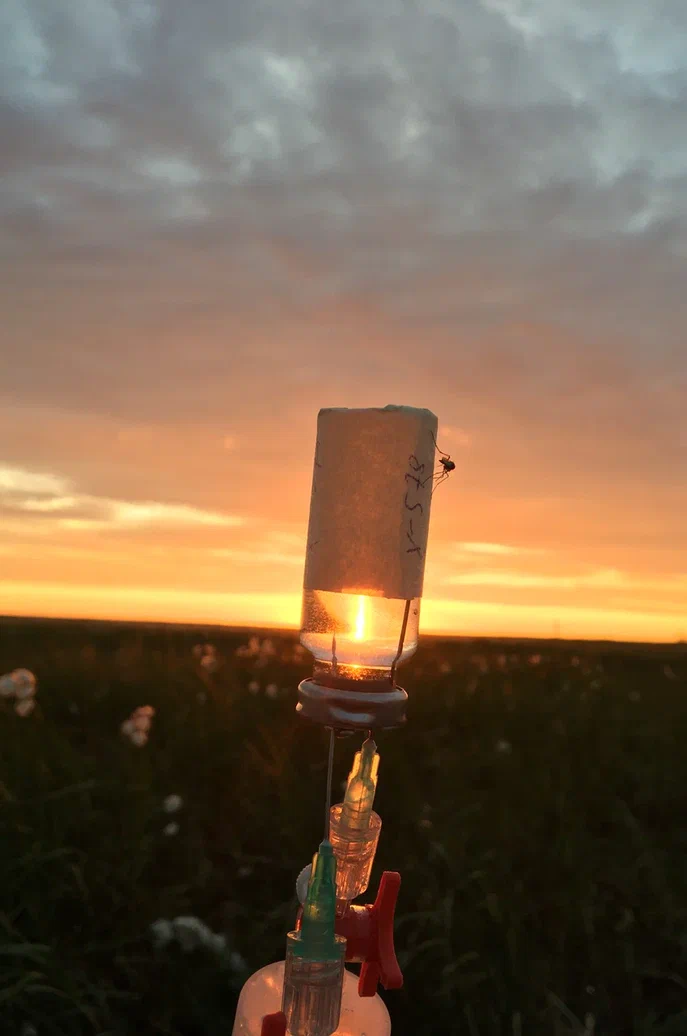
The Laboratory’s research approach integrates in situ measurements, statistical analysis, GIS-based techniques, remote sensing methods and mathematical modeling. A central component of field investigations is the measurement of methane and carbon dioxide concentrations using portable gas analyzers. These concentration measurements form the basis for calculating greenhouse gas fluxes across different ecosystem types. Field data are complemented by detailed spatial mapping based on satellite imagery and unmanned aerial vehicle (UAV) surveys.
Research Areas
— Investigation of methane and carbon dioxide emission patterns from Arctic terrestrial ecosystems, including wetlands, lakes, drained thermokarst lake basins and well-drained tundra;
— Assessment of greenhouse gas fluxes from the surfaces of large reservoirs;
— Identification of hydrological, thermal, biogeochemical and landscape controls governing the spatial and temporal variability of emissions;
— Development of methodological approaches for evaluating ecosystem services and externalities associated with greenhouse gas emissions.
Based on field observations and modeling the Laboratory develops approaches for accounting for the climate-regulating functions of ecosystems and reservoirs, assessing environmental damage and evaluating pathways toward carbon neutrality.
Achievements
— Institutional consolidation of long-term research on methane and carbon dioxide sources in the Arctic and subarctic regions;
— Establishment of unique, representative datasets on methane and carbon dioxide fluxes across tundra and wetland ecosystems;
— Derivation of seasonal emission estimates and quantitative characterization of the controlling factors of gas exchange;
— Development of mathematical approaches for describing 24-hour dynamics and spatial heterogeneity of emissions;
— Implementation of large-scale studies of emission regimes of major Siberian reservoirs with international verification by TUV Austria;
— Advancement of methodologies for assessing climate-regulating ecosystem functions, environmental damage and carbon neutrality potential;
— Presentation of research findings at national and international conferences and publication in leading peer-reviewed journals.
 |  |  |


